Money Order Scam
A money order scam involves a forged money order being passed off as genuine and being used to pay for goods or services.
It is usually drawn on an overseas bank so that it takes up to a few weeks
to verify if it is genuine.
In most of the cases of money order scams, the unsuspecting person is given
more money than needed [in the form of money orders] to complete the
purchase, and then asked to wire the excess money back.
By the time the owner of the forged money orders is advised by their bank
that they are not genuine, they have already wired money to the scammer.
This scam works based on laws that require banks to make funds available on
deposits in a short time, usually before the bank has the chance to
determine if they are counterfeit.
The banks defend this practice, noting that the person who is in the best position to know if a particular transaction is suspect, or that a particular check may be forged, is the customer.
How The Money Order Scam Works
In the most common mail order scam, the person selling an item is sent
counterfeit money orders that add up to more than the cost of the item being
advertised. The scammer offers to 'trust you' and asks you to wire the
balance using a money transfer service.
The buyer then asks the seller to deduct the amount of the purchase from the
total amount of the money order[s] and either wire the overpayment back to
them, or the overpayment may be stated as shipping costs and the buyer is
told to wire this to a shipping agent [either another scammer, or a separate
business by the same scammer].
As an example, if you were selling a car for $10,000, the scammer might send
you $15,000 in money orders, and ask for the $5,000 to be wired to a shipper
because he lives overseas and has to transport the car to his country.
Often the scammer will say that they are overseas, but that a person living
in the U.S. owes them $15,000 so they will get them to pay you because it is
difficult getting money out of their own country to pay for the car.
The money orders will be fake, and so you will have lost the amount you
wired.
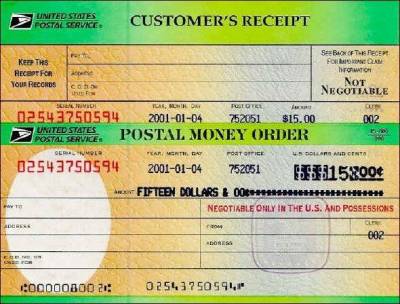
How Can you Tell if the Money Order is Fake?
The U.S. Postal Service advises that U.S. postal money orders have special security features, which can be seen by holding them in front of a light.
You should look for the following:
- A watermark of Benjamin Franklin, one of the most famous signers of the Declaration of Independence. He is visible on both the front and reverse side of the money order when held to the light
- A dark security thread running (top to bottom) to
the right of the Franklin watermark, with the tiny letters "USPS" facing
backward and forward
Domestic postal money orders never have a value of more than $1,000, and are distinguished by their green, yellow, and blue colors. Many counterfeit postal money orders have a face value of $750 to $950.
International postal money orders are printed in pink, yellow, and gold and cannot exceed $700. Postal inspectors say these counterfeit money orders usually have a face value of $500 to $700.
How to Avoid a Money Order Scam
- Get your money for your merchandise/service through a money transfer service. Its what the scammers always specify, so you can too
- Check out any online escrow service as almost all of them are operated by scammers. Do a Google search for 'escrow fraud' or 'fake escrow' first
Check out some Internet sites [like this one on Craigslist] on how to avoid a money order scam.
What to do if You are a Victim of a Money Order Scam
To verify a postal money order, call the Money Order Verification System at 1-866-459-7822.
If you suspect fraud, call the U.S. Postal Inspection Service at 1-877-876-2455 [select option 4].
Complete the FTC online complaint form.
For additional information and resources on fraudulent money orders, call the Money Order Fraud Hot Line, run by the Inspection Service's Criminal Investigative Support Center, at (800) 372-8347
Do You Have A Great Story, Tip, or Experience With This Topic?
Do you have any knowledge or experience of the money order scam to help others.
Share your story, tip or review with the world!
What Other Visitors Have Said
Click below to see contributions from other visitors to this page...
Scammer named Susan Vangalder 
She saw my ad on care.com and said she was needing my services, sent me a fake money order then wanted me to send the cash from the money order thru walmart …
Concise Survey, LLC Money Order Scam
If you receive an email from Sean Lawson of Concise Surveys, LLC to be a Mystery Shopper, it is a scam.
I received a Money Order this morning, 8/22/11, …
Shawn Thrun Not rated yet
Shawn Thrun needs to be put in jail for all the money he has taken from people. His real address is 27 Innes in west Sence New York
Money Order Scam Not rated yet
I sent a $409 money order to Shawn Thrun for an autographed basketball card. Exquisite Jordan/Lebron card /23.
He never sent the card.
He commited: …
- Home ›
- Money Order Scam